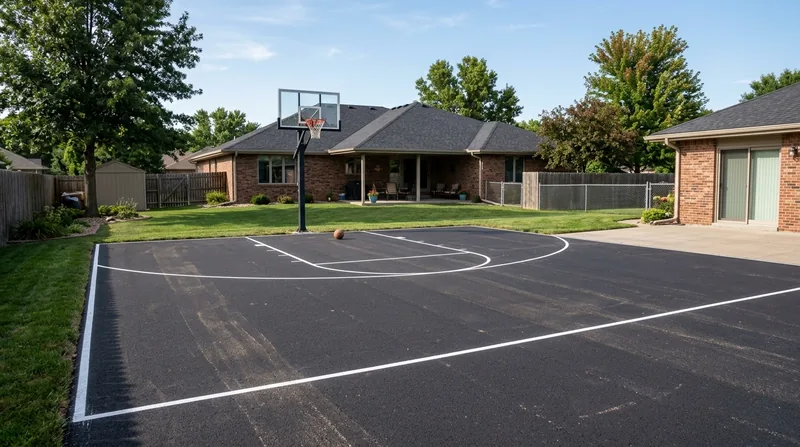




A sports court or path paving project in Lincoln sits on loess and clay that shifts every winter through freeze-thaw cycles. Without a properly graded and compacted base built to the 42-inch frost depth the City of Lincoln enforces, a new court will heave, crack, and fail by the second season. We grade and compact a stable base for the local soil conditions, then finish with hot mix asphalt that plays flat through hot summers and the repeated cold snaps that crack poorly built courts.
Lincoln's housing stock spreads from the brick neighborhoods around the Capitol out through the University district and into the post-war ranch ring, then into the subdivision belt spreading south and east across Lancaster County. Backyards in these neighborhoods are where homeowners build courts for basketball, tennis, or recreational paths. The freeze-thaw cycle that dominates this market is not gentle: the clay and loess underneath shift with every hard freeze and spring thaw, and a court built on an uncompacted base will show alligator cracking and heaving by April. That is not cosmetic damage. It is base failure, and it means the court is unsafe and unusable. The right build avoids it entirely.
Why Sports Court & Path Paving Matters in Lincoln: The Freeze-Thaw Reality
Lincoln winters are not kind to shallow or poorly compacted asphalt bases. The loess and clay that underlies the city expand and contract with every freeze-thaw cycle, and that movement will lift, crack, and break apart a court that sits on an inadequate base. A backyard court is an investment in family recreation and property value. It also has to survive the local climate.
- We grade the site to shed water away from the court and prevent pooling that accelerates freeze-thaw damage.
- We compact the base to the density and depth the local soil conditions require, following the City of Lincoln's 42-inch frost depth standard.
- We lay hot mix asphalt in a single season, before the plants close for winter, so the court is ready to play the following spring.
- We specify tonnage and thickness on every estimate so you know exactly what you are getting, not a vague "standard depth" that may not hold in Lincoln's climate.
A court built this way will play flat and stay sound through the seasonal shifts that crack courts built on shallow or uncompacted bases.
Key info: Lincoln's frost depth is 42 inches, one of the deepest in the state. A base laid without proper compaction and drainage will heave and crack every spring as the loess and clay move underneath it. Homeowners in neighborhoods like the University district, the ranch ring south and east of I-180, and the newer subdivisions in Eagle, Malcolm, and Hickman all face the same freeze-thaw challenge. The court that lasts is the one built for that reality from the start.
For more information on how we approach foundation and base work, see our page on gravel driveway installation and grading, which covers the same compaction and drainage principles.
How We Build a Sports Court in Lincoln: Step by Step
A backyard court in Lincoln starts with the ground, not the asphalt. We begin with a site visit to understand the drainage, the soil, and the layout. From there, we grade, compact, and finish with hot mix. Each step is concrete and verifiable.
- We measure the site and map the drainage pattern so water runs away from the court, not toward it.
- We excavate and remove any unstable topsoil or organic material that will not support a durable base.
- We bring in compacted stone base material and proof-roll it to ensure it will not settle or shift under the weight of the asphalt and play.
- We lay hot mix asphalt in lifts, compacting each lift to specification, and finish with a smooth playing surface.
- We provide a written estimate that includes thickness, tonnage, and the specific base preparation steps we will perform.
This process takes one to two weeks depending on the size and the weather window. A court in Lincoln is typically paved between May and October, when the asphalt plants are running and the weather is warm enough for proper compaction and curing.
Local example: A 2,800-square-foot basketball court in the older neighborhoods near the University of Nebraska required 8 inches of compacted stone base, then 3 inches of hot mix asphalt. The loess in that area is particularly soft in spring, so we proof-rolled the base twice and specified a higher compaction density. The court has stayed flat for seven years. That durability comes from building for the local soil and climate, not from cutting corners on the base.
For details on how asphalt resurfacing works if a court ever needs it, see our page on asphalt resurfacing and overlay.
| Approach | Description | Best for |
|---|---|---|
| Full court build from grade | Site grading, compacted stone base, hot mix asphalt finish, all in one season. | New courts on raw ground or sites with poor drainage or unstable soil. |
| Existing base resurface | Inspect the existing base, repair any soft spots, mill and overlay with new hot mix asphalt. | Courts that have a sound base but a worn or cracked playing surface. |
| Path paving | Grading, compacted base, and 2 to 3 inches of hot mix for recreational walking or jogging paths. | Connecting paths between driveways, courts, or through properties in subdivisions. |
| Drainage retrofit | Add or improve surface and subsurface drainage if an existing court is pooling water or heaving. | Courts showing freeze-thaw damage or standing water after rain or snowmelt. |
Sports Court & Path Paving Cost in Lincoln: What to Expect
A new backyard sports court in Lincoln starts at approximately $8,500 for a smaller court (around 2,000 to 2,400 square feet) with straightforward grading and a standard compacted stone base. Larger courts, sites with poor drainage, soft soil, or complex grading will cost more. The main factors that affect cost are the size of the court, the condition and stability of the existing ground, the depth of compaction required for the local soil, and whether new drainage work is needed.
A full-size tennis or basketball court (around 3,500 to 4,500 square feet) with proper base preparation and hot mix finish typically runs from $12,000 to $18,000. Sites in areas with heavy clay or loess, or sites that require significant grading to manage drainage, will be at the higher end. A recreational path is less expensive, usually $4,000 to $8,000 depending on length and width.
Every estimate includes the exact tonnage of base material and the thickness of the asphalt layer, so you know what you are paying for. We recommend getting two or three estimates from contractors in the Lincoln area so you can compare scope, tonnage, and price. The cheapest estimate is often the one that skips proper base compaction, and that is the court that will fail in two winters.
For a detailed pricing breakdown and current rates, see our full pricing page. To request a free estimate for your specific court or path, contact us at (402) 858-2768 or use our online form.
Sports Court & Path Paving Near Me: What to Look for When Hiring a Contractor in Lincoln
A backyard court is a significant investment, and the contractor you choose will determine whether it lasts ten years or fails in two. When you are looking for a paving contractor in Lincoln or the surrounding areas, there are a few concrete things to verify before you sign a contract.
Start by asking any contractor whether they carry liability insurance and what their coverage limits are. Request a copy of their current certificate of insurance. In Nebraska, state law requires every contractor performing construction work to register with the Department of Labor under the Contractor Registration Act before the work begins. If your court involves work at the property line or curb cut (which many do), the City of Lincoln requires a right-of-way construction permit, a $5,000 bond, and liability insurance before that work can start. Ask the contractor to explain how they will handle permitting and whether they have worked with the City of Lincoln on similar projects. Do not hire a contractor who cannot or will not answer these questions clearly.
Get written estimates from at least two contractors. A real estimate will include the size of the court in square feet, the thickness of the asphalt layer in inches, the tonnage of base material, the compaction density, and the drainage plan. If an estimate is vague or does not include these details, ask for them. A contractor who will not specify tonnage and thickness is signaling that they do not plan to build a proper base.
Ask for references from courts or paths they have built in Lincoln in the past three years. Call those references and ask how the court has held up through the winter cycles. Ask about the drainage and whether the court has cracked or heaved. A court that has survived three Lincoln winters without failure is a good sign.
If your property is in a master-planned community or an HOA, check the architectural guidelines before you hire a contractor. Some HOAs restrict asphalt in certain areas or require approval before paving work begins. Your contractor should be familiar with these rules, but it is your responsibility to verify them with the HOA before work starts.
For help finding and vetting a contractor, or to request a free estimate from us, contact Lincoln Asphalt Paving at (402) 858-2768. We are local, fully insured, and have been in business since 2013.
Sports Court & Path Paving in Lincoln: Pricing Guide
| Service | Price | Details |
|---|---|---|
| Small recreational court (2,000 to 2,400 sq ft) | Starting at $8,500 | Grading, compacted stone base, 3 inches hot mix asphalt, standard drainage, in Lincoln |
| Full-size tennis or basketball court (3,500 to 4,500 sq ft) | Starting at $12,000 | Includes site grading, deep base compaction for Lincoln's loess and clay, proper drainage, finished playing surface |
| Recreational path (per 100 linear feet) | Starting at $1,200 | Graded base, compacted stone, 2.5 inches hot mix asphalt, 6 to 8 feet wide, includes drainage slope |
| Drainage retrofit or difficult soil conditions | On estimate | Heavy clay, poor existing drainage, or significant grading required; requires site inspection and soil assessment |
| Estimate and site visit | Free | No obligation, includes measurements, soil assessment, drainage evaluation, written estimate with tonnage and thickness |
Indicative pricing, the exact cost depends on square footage, finish, and site access. Free personalized estimate within 24h at (402) 858-2768.


