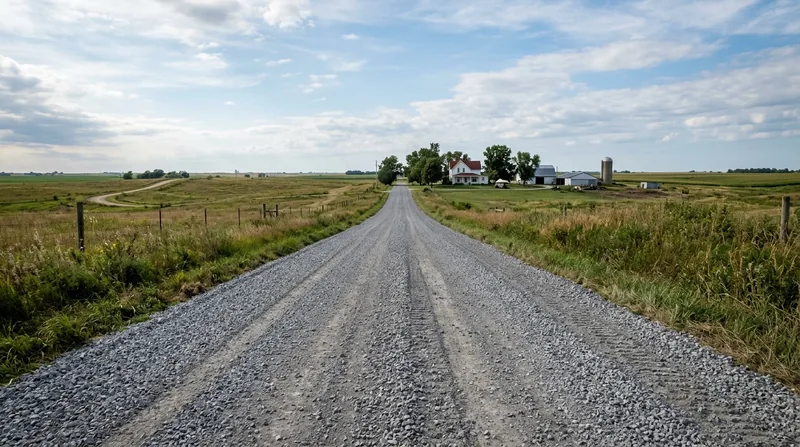




On the rural edges of Lincoln and across Lancaster County, where newer subdivisions spread south and east into open country, gravel driveway installation and grading is still the practical choice when the budget or the setting calls for it. The loess soil here is deep and workable, but it moves in freeze-thaw cycles and holds water if it is not graded and compacted right. A gravel drive that sheds water and carries traffic without rutting or washboard starts with the ground itself. We grade the base, layer in crushed rock, and compact each pass so the surface stays firm through Lincoln's hard winters and hot, windy summers. The difference between a gravel drive that lasts five years and one that becomes a muddy rut by spring is in the base preparation and the drainage. That is what we do.
Why Gravel Driveway Grading Matters in Lincoln's Loess Country
Lincoln sits on deep wind-laid loess over glacial clay, and that ground does not carry a driveway without real compaction underneath. The freeze-thaw cycle that dominates the region every spring opens cracks and heaves in any base that was not compacted to shed water. A gravel driveway on properly graded and compacted earth will carry a passenger vehicle and light truck traffic for years; one laid on uncompacted loess or clay will rut, washboard, and develop soft spots by the second spring. The City of Lincoln enforces a 42-inch frost depth for permanent structures, and while residential driveways are not subject to that rule, the principle is sound: the ground underneath has to move as one, and it will only do that if it is dense and well-drained.
- We grade the native loess to establish proper slope for water runoff away from the driveway surface.
- We lay and compact a base course of crushed rock in lifts so each layer bonds to the one below.
- We add a wearing course of smaller crushed stone on top, compacted to a firm, traffic-ready finish.
- We ensure adequate crown and edge drainage so water does not pool or undermine the base during heavy rain or spring thaw.
- We proof-roll the finished surface to confirm it carries weight without deflection or soft spots.
The result is a gravel driveway that sheds water, resists rutting, and stays passable through the wet spring season that tests every driveway in this region.
Local example: A property south of Lincoln in the Roca area with a quarter-mile gravel lane to the house sits on heavy clay. Without proper grading and compaction, that lane becomes impassable for six weeks after spring thaw. With a correctly graded base and crushed-rock layers compacted in lifts, the same lane carries traffic all year and requires only annual grading and top-dressing to stay in service.
Verify your local grading and drainage requirements with the City of Lincoln Public Works Department or your village clerk if you are outside city limits. Some jurisdictions have stormwater rules that affect how you grade a driveway, especially if it is near a wetland or in a flood-prone area.
How We Grade and Install a Gravel Driveway in Lincoln
The work starts with a site walk to understand the lay of the land, the soil type, and where water naturally wants to go. We measure the driveway length and width, check for utilities underground (Nebraska 811 locates are required by law before any excavation), and plan the grade and drainage. From there, we execute the work in stages, with proof rolling and inspection between each lift so we know the base is solid before we move to the next step.
- We call 811 to locate buried utilities (gas, electric, water, sewer, fiber) before any excavation begins.
- We strip and grade the subgrade to establish the cross-slope and drainage pattern.
- We lay the base course of larger crushed rock (typically 3 to 4 inches compacted) and run the roller over it until it is firm and bonded.
- We add the intermediate course of medium crushed stone (2 to 3 inches) and compact it in the same way.
- We finish with a wearing course of smaller crushed stone or marble chips (1 to 2 inches) for a smooth, stable surface.
- We proof-roll the finished driveway and make any corrections needed before we sign off.
The whole process typically takes one to two days for a standard residential driveway, depending on length, width, and ground conditions. If the ground is wet or the base is deeper than expected, the job may take longer.
Real example: A 250-foot driveway in Eagle with a steep slope to the house and heavy clay subgrade took one full day to grade, two lifts of base course, one lift of intermediate course, and a wearing course. The owner wanted to keep costs down and avoid asphalt, so we built it to shed water and carry light truck traffic. Five years later, it still looks good because the base was compacted right and the crown moves water off the surface.
If you are considering a longer private road or a shared HOA lane, see our page on private road and HOA paving for larger-scale grading and surface options.
Gravel Driveway Installation Methods and Materials
| Approach | Description | Best for |
|---|---|---|
| Three-course crushed rock | Base, intermediate, and wearing courses of progressively smaller stone, each compacted in lifts. | Standard residential driveways where durability and drainage are priorities. |
| Recycled asphalt millings | Reclaimed asphalt chunks and fines that compact and bind together under traffic and weather. | Budget-conscious owners who want a firmer, longer-lasting surface than loose gravel. |
| Marble chips or decorative stone | High-end wearing course over a compacted crushed-rock base for aesthetic appeal. | Properties where appearance is a priority and budget allows for premium material. |
| Grading and re-compaction only | Regrading an existing gravel driveway, removing washboard and soft spots, and re-compacting the surface. | Established driveways that have settled or rutted and need restoration without full reconstruction. |
Gravel Driveway Installation and Grading Cost in Lincoln: What to Expect
A basic gravel driveway installation in the Lincoln area runs starting at $950 for a short residential driveway with straightforward grading and standard crushed-rock materials. The actual cost depends on several factors: the length and width of the driveway, the slope and drainage challenge, the soil type and compaction difficulty, the distance we have to haul material, and the type of wearing course you choose. A 150-foot driveway with moderate slope and clay subgrade will cost more than a 100-foot drive on level, sandy ground. A driveway with recycled asphalt millings as the wearing course will cost more than one with standard crushed stone. A longer private road or a driveway that requires significant fill will push the estimate higher.
The best way to know what your job will cost is to get a written estimate on site. We measure the driveway, assess the ground, and give you a tonnage spec and a firm price before we start. Do not rely on a per-square-foot quote from a contractor who has not seen the site; grading and compaction are labor-intensive, and the cost depends on what is underneath the surface, not just the square footage on top. We provide written estimates with tonnage specifications so you know exactly what you are getting.
See our pricing page for more detail on how we estimate gravel driveway work and what factors move the cost up or down.
Gravel Driveway Installation and Grading Near Me: What to Look for When Hiring a Contractor in Lincoln
A gravel driveway is less expensive than asphalt, but it still requires skill and the right equipment to do it right. When you are looking for a contractor to grade and install a gravel driveway near you in Lincoln or the surrounding towns, verify that the contractor is fully insured, has a physical address in the area, and can show you examples of previous work. Ask for references from recent jobs and call them. Understand what the estimate includes: tonnage, compaction method, equipment, and the timeline. If a contractor offers a price that is too good to be true, ask questions about what is being cut. If there is no written contract, no tonnage spec, and a request for a large cash deposit before work starts, walk away.
- Verify that the contractor carries liability insurance and can provide a current certificate on request.
- Check that the contractor has a local address and local equipment, not out-of-state plates and a traveling crew.
- Get a written estimate that includes the driveway dimensions, tonnage of each material course, equipment to be used, and the total price.
- Ask for at least two references from jobs completed in the last two years and call them to ask about quality and timeliness.
- Understand your local permitting requirements by checking with the City of Lincoln or your village clerk before the work starts.
- If you live in an HOA community, verify that a gravel driveway meets your architectural standards before you hire anyone.
Call us at (402) 858-2768 for a free, no-obligation estimate. We have been in business since 2013, we are based in Lincoln, and we can walk you through the whole process.
Gravel Driveway Installation & Grading in Lincoln: Pricing Guide
| Service | Price | Details |
|---|---|---|
| Standard residential gravel driveway (150-200 feet) | Starting at $950 | Includes grading, three-course crushed rock base and wearing course, compaction, and proof rolling. |
| Recycled asphalt millings driveway (150-200 feet) | Starting at $1,200 | Grading and base prep plus recycled asphalt wearing course, which hardens under traffic and lasts longer. |
| Regrading and re-compaction of existing gravel driveway | Starting at $650 | Removes washboard and soft spots, re-establishes crown and drainage, re-compacts surface without new material. |
| Longer private road or complex grading (400+ feet, steep slope, or poor soil) | On estimate | Requires on-site assessment to determine material volume, compaction difficulty, and equipment time needed. |
| Travel and site visit | Included | No separate mileage fee or call-out charge within Lincoln and surrounding Lancaster County service areas. |
| Free written estimate | No cost | Includes dimensions, tonnage specs, materials, and timeline. Response within 24 hours at (402) 858-2768. |
Indicative pricing, the exact cost depends on square footage, finish, and site access. Free personalized estimate within 24h at (402) 858-2768.


